




Mercury Z FiberWorkforce.com Powered byMercury Z
Hire talent Browse open jobs
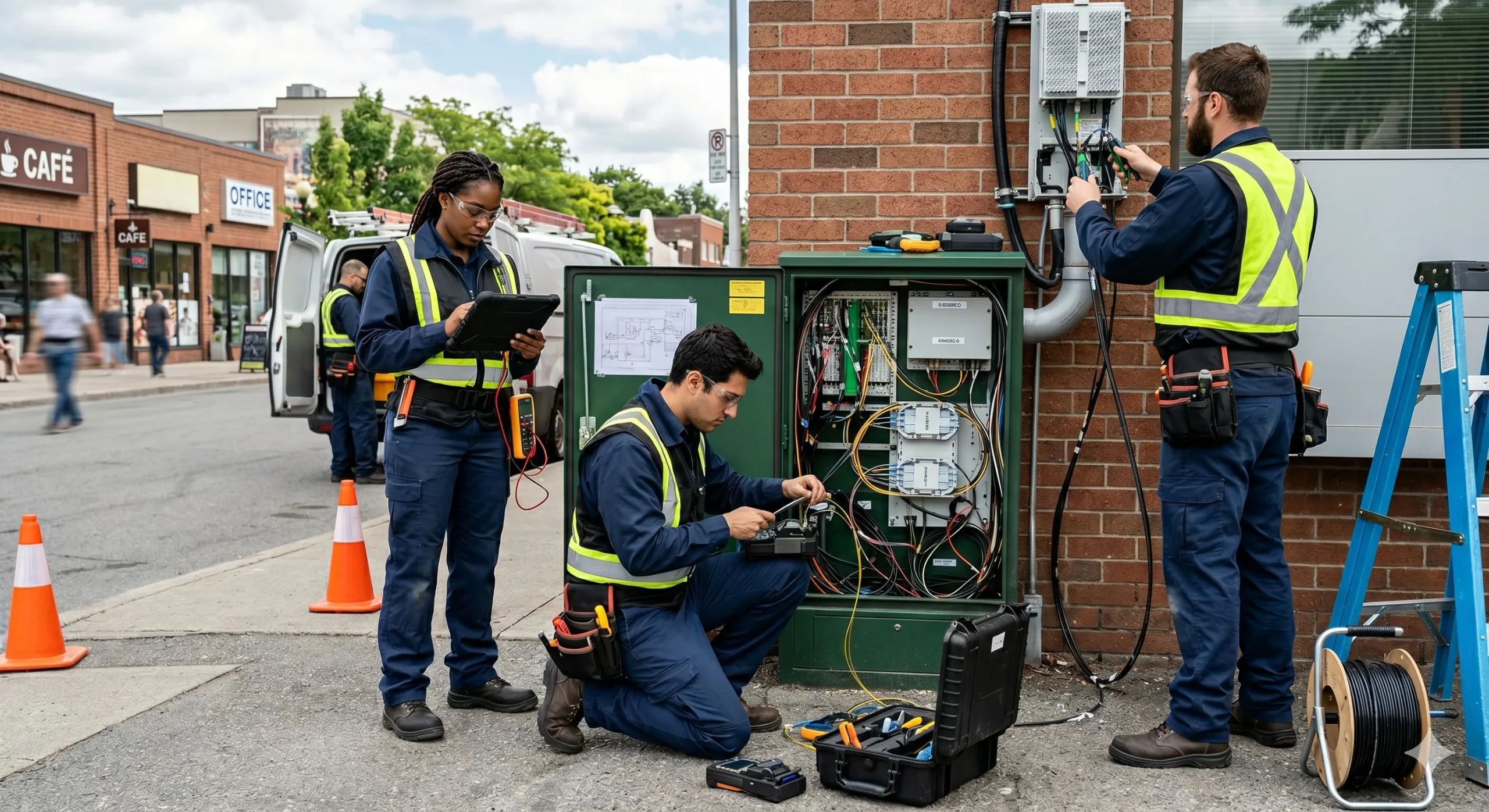
Field technicians at work
America's tech workforce platform

The workforce behind
America's network.

500,000+ skilled tech workers short. $3 trillion in infrastructure being built right now. We put pre-vetted, certified field technicians on projects in 24–48 hours — and keep traveling techs working back-to-back.

24–48h Average technician deployment time
$3T+ U.S. infrastructure build underway
500K+ Skilled tech worker shortage in the U.S.
8+ Active deployment markets
What we do

Field-ready talent. Deployed fast.

We don't post job boards and wait. We maintain a Virtual Bench of pre-vetted, credentialed technicians — staged and ready before your order arrives.

Fiber & telecom field crews

OSP/ISP deployment, fiber splicing, FTTH, aerial and underground construction, 5G densification — mobile crews for large-scale carrier buildouts.

Join the bench →

Business tech services (BTS)

CCNA-certified enterprise IT field techs — WAP deployments, structured cabling, data center builds, SD-WAN, firewall implementation, and NOC support.

Data center builds are booming →

The Virtual Bench model

Every technician is pre-screened, background checked, and credentialed before you call. When you need coverage, we deliver in 24–48 hours — not two weeks.

Hire from the bench →
Roles we staff

Five crafts. Steady deployment.

Apply in minutes

Fiber Splicer

FOA/ETA certification, splicing experience. AL, TX, IN, LA priority.

CCNA Network Tech

Cisco CCNA plus low-voltage experience. All markets.

Journeyman Electrician

State journeyman license. AL, TX, NV priority.

Rack & Stack Specialist

Data center experience, OSHA 30. All markets.

Starlink Installer

Starlink Business cert — or we train you. All markets.

How it works

Simple. Fast. Reliable.

01

Tell us what you need

Submit your project scope, location, certifications required, and timeline. Takes 5 minutes.

02

We match from the bench

We pull from pre-vetted, credentialed technicians already staged in your market — no recruiting lag.

03

Deploy in 24–48 hours

Your tech is on-site and executing. Background checked, compliant, and ready to work from day one.

04

Scale as needed

Single tech or 50-person deployment — we've got the bench depth for full crews across markets.

Where the work is

Active across the Southeast and expanding

Currently deploying technicians across 8+ markets with national expansion underway. Demand cascades — where one project lands, more follow for 12–24 months, and the per diem runs the whole time.

Alabama Tennessee Georgia North Carolina Texas Virginia Florida South Carolina Expanding nationally
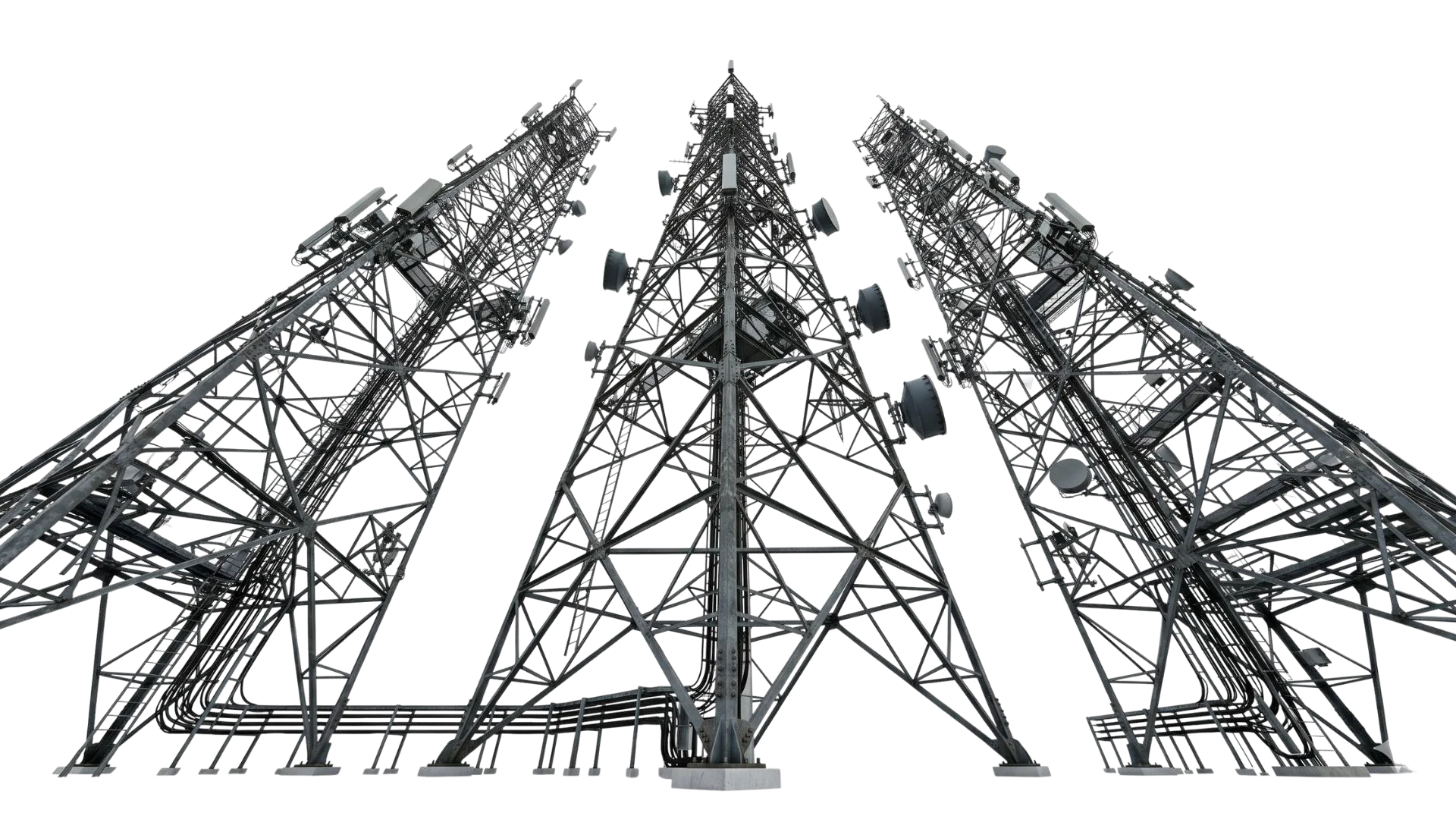
Cell towers at dusk
Field Workforce Insights

Latest from the blog

All insights →
The traveling tech list

Market alerts and per diem math, monthly

New markets, new openings, and the guides — straight to your inbox. No spam, unsubscribe anytime.

You're on the list. First issue lands next month.

For employers ·Mercury Z

Ready to build America's network?

Whether you need a single certified technician or a full deployment crew across multiple markets — we're ready when you are. Tell us about your site and we'll scope it within one business day.

Get talent now
Insights

Field workforce insights

The per diem math, the market intel, and the career guides for traveling fiber and field techs. Written by the team that runs the deployments.

Data center aisle Field Workforce Insights · July 2026 The data center boom: why skilled field techs are the most valuable people in the room Hyperscalers are announcing billion-dollar campuses — and none of it gets built without the people on the floor. What the boom means for rack-and-stack crews, cable techs, and network engineers. Read the post → Cell towers Field Workforce Insights · July 2026 Why Starlink Business is changing commercial connectivity — and why certified installers are in demand Enterprise-grade satellite is becoming the primary connectivity layer for job sites, stadiums, and carrier deployments. The bottleneck isn't equipment — it's certified installers. Read the post → Field technician Career Insights · July 2026 Traveling tech work: the financial case no one is talking about Per diem, tax treatment, overtime exposure — when you run the full math, a traveling tech position outperforms a comparably-titled fixed job by a surprising margin. Read the post →
← All insights Field Workforce Insights · July 2026

The data center boom: why skilled field techs are the most valuable people in the room

Everyone is talking about the AI-driven data center buildout. Hyperscalers are announcing billion-dollar campuses. Secondary markets are suddenly on the map. Real estate developers are converting industrial sites overnight.

What doesn't get talked about nearly as much: none of it gets built without the people on the floor.

Rack-and-stack crews. Cable technicians. Low-voltage electricians. Network engineers who can terminate a fiber run, configure a switch, and hand a clean site to the cloud team by end of shift. These are the professionals making the AI infrastructure revolution physically real — and right now, they're in higher demand than the market has seen in years.

The scale of what's being built

Let's put some numbers on this.

According to the 2025 Dodge Construction Network report, data center construction starts in the U.S. hit a record high, with more than $40 billion in new projects underway or planned. That's not just the headline coastal markets. It's Birmingham, Huntsville, Montgomery. It's the Midwest. It's secondary markets that suddenly have the power infrastructure, land costs, and tax incentives to attract enterprise-grade facilities.

The drivers are straightforward: AI model training and inference requires enormous compute capacity, and that compute lives in physical data centers. The hyperscalers — AWS, Google, Microsoft, Meta — are all expanding simultaneously. Telecom carriers are upgrading edge data centers to support 5G and edge compute workloads. And colocation providers are racing to keep up with demand.

The IEA estimated in its 2026 report that data center electricity consumption could double by 2030. That's not an abstract projection — it's already showing up in construction pipelines, RFQ activity, and workforce shortages.
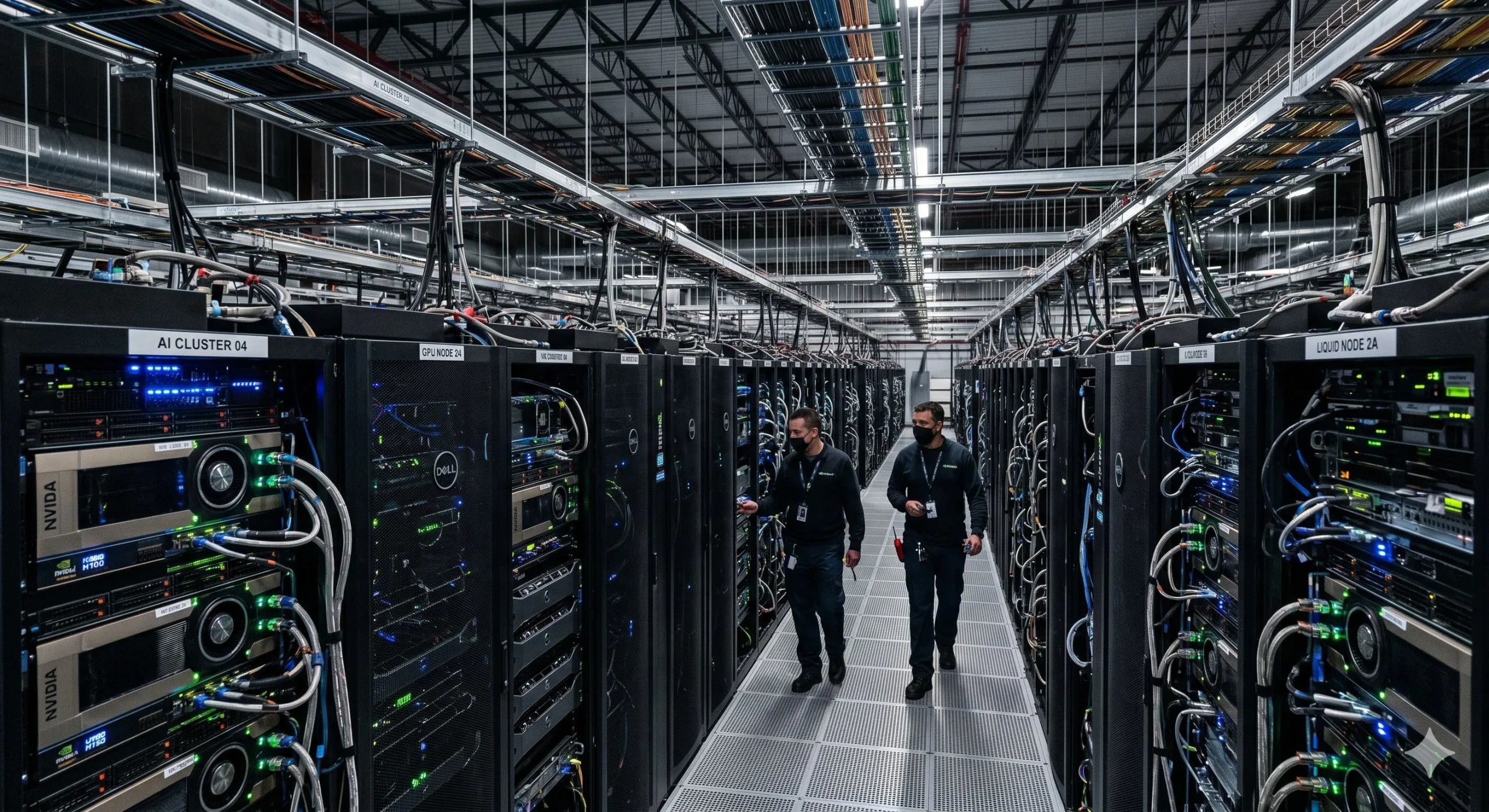
Data center server aisle

What "skilled field tech" actually means in a data center build

There's a persistent misconception that data center work is primarily an IT job — something done remotely, by engineers in air-conditioned offices. The physical reality is completely different.

Before a rack serves a single workload, a team of skilled field professionals has to:

Survey and prepare the space. This includes floor plans, cable pathway design, raised floor or overhead tray routing, and power distribution verification. None of this happens on a laptop in another state.

Rack and stack hardware. Physical installation of servers, switches, patch panels, PDUs, and cable management systems. Precise work, often under time pressure, often with millions of dollars of hardware being handled.

Run structured cabling. Fiber runs, copper runs, cable termination, testing, and labeling to spec. In a Tier 3 or Tier 4 facility, structured cabling must meet strict standards — a bad termination doesn't get you a mulligan.

Low-voltage and electrical work. Data centers run at 400V+ in many modern facilities. The electricians and low-voltage specialists who work these jobs need proper credentials and experience.

Configure and commission. Once the physical infrastructure is in place, network technicians bring it online — configuring switches, verifying connectivity, running acceptance tests.

Documentation. As-built drawings, rack elevations, cable labeling, test results. Without it, the facility team can't maintain what you built.

Every one of these steps requires people who know what they're doing. You can't automate a fiber termination. You can't outsource rack-and-stack to a chatbot.

Secondary markets are where the opportunity is biggest

The hyperscaler campuses in Northern Virginia and Phoenix get the headlines. But the most interesting workforce opportunity right now is in the secondary markets where the next wave of capacity is being built.

Places like:

  • Huntsville, AL — Defense infrastructure, DoD data center expansion, strong power grid
  • Birmingham, AL — Lower land costs, growing industrial base, proximity to Atlanta without Atlanta prices
  • Montgomery, AL — State government tech investment, Mercedes-Benz manufacturing infrastructure spillover
  • Midwest secondary markets — Columbus OH, Indianapolis IN, Des Moines IA — all seeing significant data center investment driven by available land, renewable energy, and favorable tax treatment

For Mercury Z, these are exactly the markets we operate in. And the pattern is consistent: where a major data center project is announced, a cluster of field tech demand follows — and stays for 12–24 months through the construction and commissioning phases.

The challenge for most field technicians is mobility. These projects are where the work is, and being willing to travel — with the per diem economics that traveling tech work provides — puts skilled professionals in a very different position than those anchored to a single market.

The economics of being a traveling data center tech

Here's what the financial picture actually looks like for a skilled field tech willing to travel.

A network technician or rack-and-stack specialist working on data center projects in secondary markets can typically earn:

  • Base hourly rate: $32–$52/hour depending on certifications and specialty
  • Per diem: $75–$100/day tax-free (housing + meals)
  • Over a 26-week deployment: $14,000–$18,200 in per diem alone — tax-free

That per diem income is the number most people in the industry still underestimate. It doesn't count toward your taxable income the same way wages do. Over a full year of traveling work, a technician can receive $28,000–$36,000 in per diem — money that doesn't trigger the same tax burden as an equivalent salary increase would.

The result: a traveling data center tech earning $42/hour with $90/day per diem is in a materially better financial position than a locally-anchored tech earning $50/hour with no per diem — even before accounting for overtime, certifications, or career progression.

What Mercury Z is doing about the workforce gap

Mercury Z built its model specifically around this dynamic. Field techs who want to work on significant infrastructure projects — data centers, carrier networks, stadium deployments — shouldn't have to navigate a fragmented placement market to find the next good contract.

Our platform connects credentialed technicians with the data center projects, carrier deployments, and commercial construction engagements that need them. We manage per diem, travel logistics, and compliance — so technicians can focus on the work.

For GCs and data center operators, Mercury Z offers a managed field workforce that can staff up for a project, execute to spec, and document properly. One point of contact, vetted technicians, performance accountability.

What to do if you're a field tech right now

If you have structured cabling, low-voltage, network, or electrical credentials — and you're willing to travel — the data center boom is one of the best labor markets you'll see in your career.

The window is open. Data center construction typically runs 18–36 months from groundbreaking to commissioning. Secondary market projects are ramping now, and the demand for experienced field techs in those markets will sustain through at least 2027.

Mercury Z is actively deploying teams in data center markets across Alabama, Texas, Indiana, Louisiana, Nevada, and expanding.

Ready to put your credentials to work on the projects that matter?

Visit mercuryz.com/careers and apply today — we'll reach out within 24 hours.

Mercury Z is a field operations partner specializing in data center infrastructure, carrier network deployments, and Starlink Business installations. We serve enterprise clients and GCs across 29+ markets.

← All insights Field Workforce Insights · July 2026

Why Starlink Business is changing commercial connectivity — and why certified installers are in demand

There's a shift happening in commercial connectivity that most IT teams are still catching up to. Starlink Business — SpaceX's enterprise-grade satellite internet service — is no longer just a fallback option for rural sites. It's becoming the primary connectivity layer for construction sites, stadium events, carrier deployments, and enterprise campuses where laying fiber isn't fast enough or economically viable.

And as the deployments scale up, one thing is becoming clear: the bottleneck isn't equipment. It's certified installers.

What Starlink Business actually delivers

The Starlink Business tier is different from the residential product most people know. It runs on dedicated capacity with speeds ranging from 100–500 Mbps down and latency as low as 20–40ms — numbers that weren't achievable via satellite just five years ago. SpaceX's second-generation satellites, combined with flat high-performance dish arrays, have changed the physics of what satellite internet can do.

What does this mean in practice?

  • A construction site with 50+ workers can run VoIP, project management software, and security camera feeds simultaneously.
  • A stadium or event venue can deploy Starlink as a temporary network for broadcast, ticketing, and staff communications — without waiting for a carrier to run new fiber.
  • A data center or enterprise campus in a secondary market can get Tier 1 connectivity without a 12-month fiber construction timeline.

According to SpaceX, Starlink Business has been deployed in more than 100 countries, with enterprise and government contracts accelerating through 2025 and 2026. In the U.S., major carriers including Lumen Technologies have begun integrating Starlink into their enterprise service portfolios — which means carrier-driven deployments are now a market in their own right.

Communications towers

The deployment complexity most people underestimate

Here's what's easy to miss from the outside: Starlink Business is not a plug-and-play product at enterprise scale. A clean commercial deployment requires:

Physical installation expertise. The Flat High Performance dish requires precise orientation, proper mounting hardware (pole, wall, roof, or ground), and cable management that meets commercial building standards. Done wrong, you get poor performance or a warranty-voiding installation.

Network integration. Starlink Business doesn't just hand off an IP address and walk away. It needs to integrate with existing SD-WAN environments, failover configurations, VLAN setups, and firewall policies. Most enterprises run Peplink, Cisco Meraki, or similar — and knowing how Starlink's routing behavior interacts with those platforms is non-trivial.

Site survey and RF awareness. You need a clear view of the northern sky (in the Northern Hemisphere). Obstructions, interference sources, and cable routing all affect performance. A proper pre-installation site survey isn't optional — it's the difference between a clean handoff and a callback.

Commissioning and documentation. Enterprise clients need speed test records, photos, configuration documentation, and sign-off. Carriers require this before paying.

None of this is difficult for someone who knows it. But it requires training, field experience, and certification — not just a willingness to climb on a roof with a wrench.

Why the market is outrunning the certified installer supply

Starlink's growth trajectory has created a skills gap that the traditional telecom workforce hasn't caught up to yet.

The issue is twofold. First, Starlink Business deployments are relatively new at scale, which means the pool of technicians with real field experience is still small. Second, the certification pathway through SpaceX's channel programs is not widely known or accessible to independent technicians.

Mercury Z saw this gap forming in early 2025 and made a deliberate decision: build a certified Starlink installation team before the demand curve hit. That meant investing in technician training, aligning with carrier deployment programs, and establishing operational playbooks for the full installation workflow.

The result is a field team that can handle commercial Starlink deployments from site survey through final commissioning — and the documentation to prove it to enterprise clients.

For carriers rolling out managed Starlink services to their enterprise customers, this kind of plug-in field operations capability is exactly what they need. They have the customer relationships and the service contracts. They need trusted partners who can execute in the field at scale, across multiple markets.

What certified installer demand looks like right now

The demand signals are consistent:

Data centers: Secondary-market data center sites — especially in markets like Birmingham, Montgomery, Huntsville, and emerging Midwest locations — increasingly need connectivity solutions that don't require a 6–12 month fiber build timeline. Starlink Business fills that gap, and certified installers are needed to execute.

Construction and GC-driven projects: Major general contractors running large commercial construction projects need job site connectivity for safety systems, project management, and crew communications. Mercury Z has active relationships with GCs like Mortenson, Turner, and DPR — all of whom have connectivity needs on active job sites.

Carrier program deployments: As Lumen and other carriers build out managed Starlink service offerings for their enterprise customer base, they're creating demand for channel partners who can staff field deployments at scale. This is a recurring, high-volume opportunity.

Stadiums and event venues: Large-scale events need temporary or supplemental Starlink deployments for broadcast-quality connectivity. Mercury Z's team has experience in stadium environments, with installations supporting 5,000+ concurrent users.

What this means if you're a field tech

If you're a network technician, cable technician, or field electrician, Starlink certification is rapidly becoming one of the most valuable credentials you can add. Here's why:

The hardware is new. It's going everywhere. Experienced Starlink installers are still rare enough that certified techs have significant leverage in the job market. And because Starlink deployments often happen in markets where other tech work is also expanding — data centers, carrier network upgrades, commercial construction — you're rarely going to a market for one job.

Mercury Z offers Starlink certification training as part of its technician development program. If you're already credentialed in networking or low-voltage work, you can get up to speed quickly and start deploying commercially.

The bottom line

Starlink Business is growing faster than the installer base can keep up. The technology has crossed the threshold from "interesting alternative" to "enterprise-grade primary option" — and the deployment machine needs skilled, certified people to make it work.

For Mercury Z, this is the moment the company has been building toward. And for field technicians who want to be on the right side of the next wave of infrastructure work, Starlink certification is the move.

Ready to get certified?

Visit mercuryz.com/careers to learn about Mercury Z's Starlink technician program and open field positions.

Mercury Z deploys certified field teams for Starlink Business installations, carrier deployments, and enterprise connectivity projects, operating across markets nationwide. Contact us at info@mercuryz.com or apply at mercuryz.com/careers.

← All insights Career Insights · July 2026

Traveling tech work: the financial case no one is talking about

Most conversations about tech careers focus on the same things: salary bands, benefits, PTO, remote work flexibility. What almost never gets discussed clearly — even by people who've done it — is what traveling field tech work actually pays.

Not the headline hourly rate. The full picture.

When you factor in per diem, tax treatment, overtime exposure, and the density of high-value projects in secondary markets, the math changes substantially. And in most cases, a traveling tech position outperforms a comparably-titled fixed-location job by a margin that would surprise most people.

This is the financial case that doesn't get a clear explanation. Let's fix that.

The piece everyone skips: per diem

Per diem is a tax-advantaged daily allowance that employers provide to cover meals and incidental expenses (M&IE) when employees work away from their tax home. When structured properly under IRS accountable plan rules, per diem is not included in your taxable income.

This is the number that changes the calculation.

The federal per diem rate for most continental U.S. markets ranges from $59–$79/day for M&IE alone. Field operations companies typically pay $75–$100/day for techs on traveling assignments.

$23,400 in tax-free income At $90/day, working 260 days in a year.

Here's what that means in real terms: $23,400 in per diem is not equivalent to $23,400 in salary. Because salary is taxed — at a combined federal/state effective rate of roughly 22–28% for most working professionals — you'd need to earn $30,000–$32,000 in additional salary to net the same amount after taxes.

That's the math most people in the industry either don't explain or don't know.

A side-by-side comparison

Let's make it concrete. Take two field network technicians with comparable credentials — both CCNA-certified, both with 5 years of experience.

Tech A — fixed location role (major metro)
  • Annual salary: $72,000
  • Benefits: health + 401k match
  • No per diem
  • Effective hourly: ~$34.62
Tech B — Mercury Z traveling role
  • Hourly rate: $38/hour
  • Hours per year (standard): 2,080
  • Gross wages: $79,040
  • Per diem: $90/day × 245 working days: $22,050 (tax-free)
  • Benefits: health included
  • Total: $79,040 taxable + $22,050 tax-free

When you account for the tax advantage on per diem, Tech B's total economic value is equivalent to a $97,000–$100,000+ salary at Tech A's location — without any additional career progression or overtime.

And overtime is real in this work. Data center builds, carrier deployment ramps, and stadium projects run on tight timelines. It's not unusual for field techs to see 45–55 hour weeks during peak deployment. At $38/hour, every hour over 40 pays $57.

The market keeps sending work to the right places

Here's the other dynamic: the projects that need field techs are not uniformly distributed. They cluster in secondary markets — exactly the markets where traveling tech professionals go.

Why does this matter financially?

Because when Mercury Z sends a tech to Birmingham for a data center project, that same market often has concurrent demand from a carrier upgrade, a commercial construction project, and a Starlink deployment. The infrastructure investment in a market tends to cascade — utilities upgrade, carriers follow, GCs bring data center work, commercial construction fills in around it.

A traveling tech who knows those markets and has the credentials to work across project types can maintain near-continuous deployment — with per diem running the whole time.

Compare that to a fixed-location tech in a high-cost market who has to compete for the same handful of local contracts and can't pick up work 40 miles away without it becoming a lifestyle disruption.

The credential multiplier

The earning trajectory in traveling tech work compounds differently than it does in fixed roles.

In a fixed corporate IT role, salary bands are often rigid. A 3–5% annual raise is typical. Breaking out of a band usually requires a title change that may or may not align with what's actually available at a given company.

In traveling field tech work, adding a credential directly unlocks higher-paying project categories. The path looks like this:

Credential added Typical rate impact
Starlink Business Certification +$4–8/hour on Starlink-specific work
BICSI INST1 or INST2 +$3–5/hour on structured cabling projects
CCNA + network field experience +$6–10/hour over unlicensed network techs
Journeyman Electrician License Opens entire category of electrical field work
OSHA 30 Required for many data center/GC projects — table stakes

Each credential opens a category. And because you're traveling, you're not competing only for what's available locally — you can go where that credential type is in demand.

The 4-year horizon

Here's a framing that Mercury Z uses in recruiting because it's accurate: what does the earning picture look like over 4 years for a traveling tech professional vs. a fixed-location peer?

A traveling tech will accumulate significantly more wealth in 4 years than a peer on a fixed $70,000–$80,000 salary, even when the fixed-location peer receives modest annual raises. The combination of higher effective hourly rate, tax-advantaged per diem, and overtime exposure closes the gap — and often reverses it.

This isn't theoretical. This is the experience of the technicians on Mercury Z's active roster.

What it actually looks like in practice

A realistic traveling tech week on a Mercury Z assignment:

  • Monday: Arrive on site. Site survey, equipment check-in, rack layout review.
  • Tuesday–Thursday: Active installation work. 9–11 hours/day typical during build phase.
  • Friday: QA, documentation, punch list, sign-off.
  • Saturday flight home (or extended if back-to-back project weeks).

Per diem runs from travel day through return. Hotel and flights are covered by Mercury Z. Your paycheck covers your actual expenses at home — because your road expenses are covered.

The lifestyle is real. It's not for everyone. But for a technician who is wired for field work and doesn't mind travel, the financial case is clear.

The part worth saying plainly

There's a version of this career path where a field tech spends 10 years slowly climbing a salary band at a fixed job, reaches $85,000, and wonders why the wealth accumulation isn't there.

And there's a version where that same tech, with the same base credentials, spends 4–6 years doing traveling field work — building certifications, accumulating per diem, working on infrastructure projects that matter — and is in a fundamentally different financial position.

Mercury Z exists specifically to make the second path accessible and well-organized for technicians who are ready for it.

The math is on your side. The work is out there.

Visit mercuryz.com/careers to see open field positions across Mercury Z's markets.

Mercury Z connects certified field technicians with data center, carrier, Starlink, and commercial construction projects across 29+ markets. We handle logistics, compliance, and per diem so you can focus on the work.